
Programmable atom arrays
Floquet-tailored Rydberg interactions
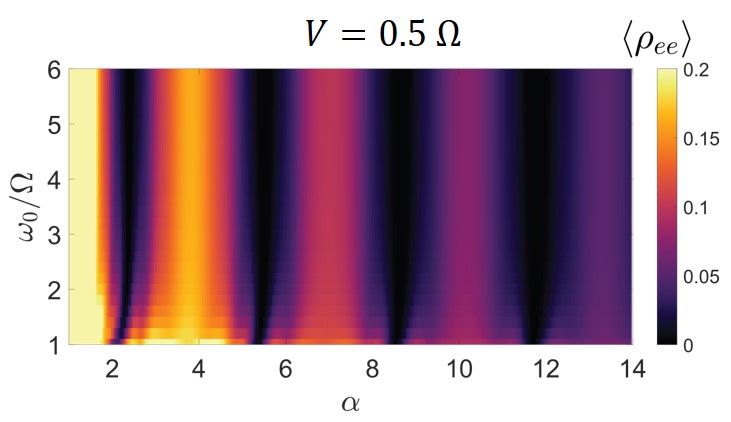
Quantum processors generally benefit from increased qubit connectivity, improved coherence, and new state-initialization pathways. We show that neutral atom quantum processors can be advanced on all three critical fronts through a simple, robust approach – Floquet frequency modulation:
- We demonstrate Rydberg-blockade entanglement beyond the conventional blockade radius for two tweezer-trapped atoms and showed how the enlarged entanglement range improves qubit connectivity in a neutral atom array.
- We find that the coherence of entangled states can be protected against Doppler dephasing, which is the dominant mechanism limiting entangled-state coherence in atom arrays.
- We propose a robust method to realize Rydberg anti-blockade states in the steady state for two closely-spaced atoms, which cannot be otherwise achieved with a conventional static drive.
Nat. Commun. publication, CQT highlight
Scaling up atom arrays
Efficient defect-free atom array assembly

We realize large pristine arrays containing hundreds of atoms with high success rates by using a new algorithm that moves multiple atoms at the same time. Defect-free arrays of atoms are an important platform for quantum simulation and quantum computing, and large arrays allow us to harness more atoms for increased simulation and computing power. However, producing large defect-free arrays can be challenging because of the losses encountered during assembly. One way to beat the losses is to build the arrays as quickly as possible. Our new algorithm achieves a significant speedup over existing algorithms by using multiple tweezers to sort atoms in parallel. We have also used our new algorithm to create a range of pristine patterns including a honeycomb and a lion head.
Phys. Rev. Applied publication, APS Physics highlight, NUS news highlight, Phys.org, CQT highlight
Magic wavelength tweezers
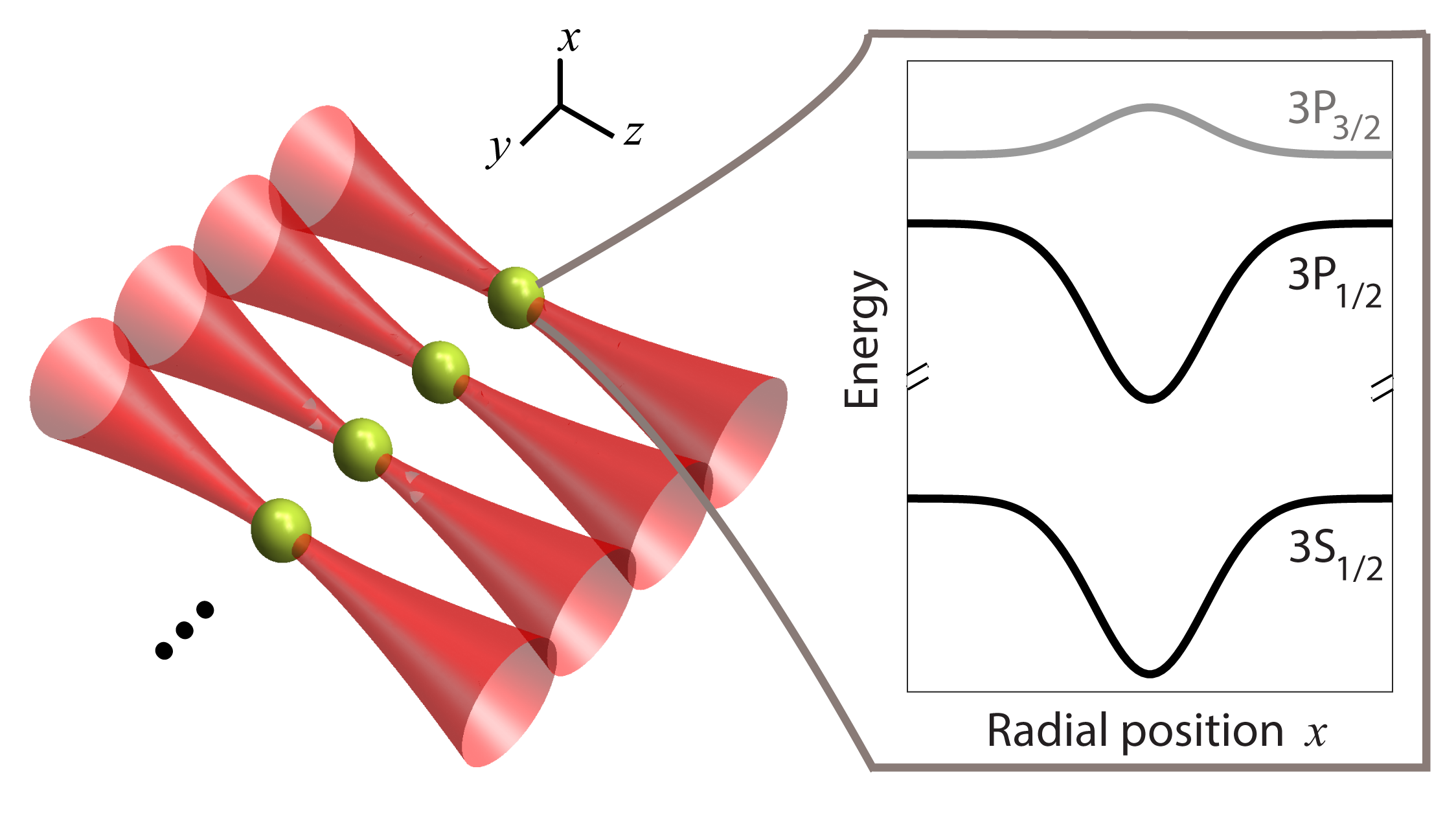
We use a new class of magic wavelengths (for the D1 transition in alkalis) to achieve an order-of-magnitude reduction in the optical power required per tweezer trap, which allows us to scale up the atom array size correspondingly.
Phys. Rev. Research publication, CQT highlight