
Advanced materials like superconductors have the potential to change energy transport as we know it. However, their dynamics on the microscopic scale remain poorly understood as they are difficult to simulate with classical computers. A promising solution is to assemble ultracold atoms as quantum building blocks to mimic these advanced materials and directly observe the dynamics in these clean systems.
Hilbert space fragmentation
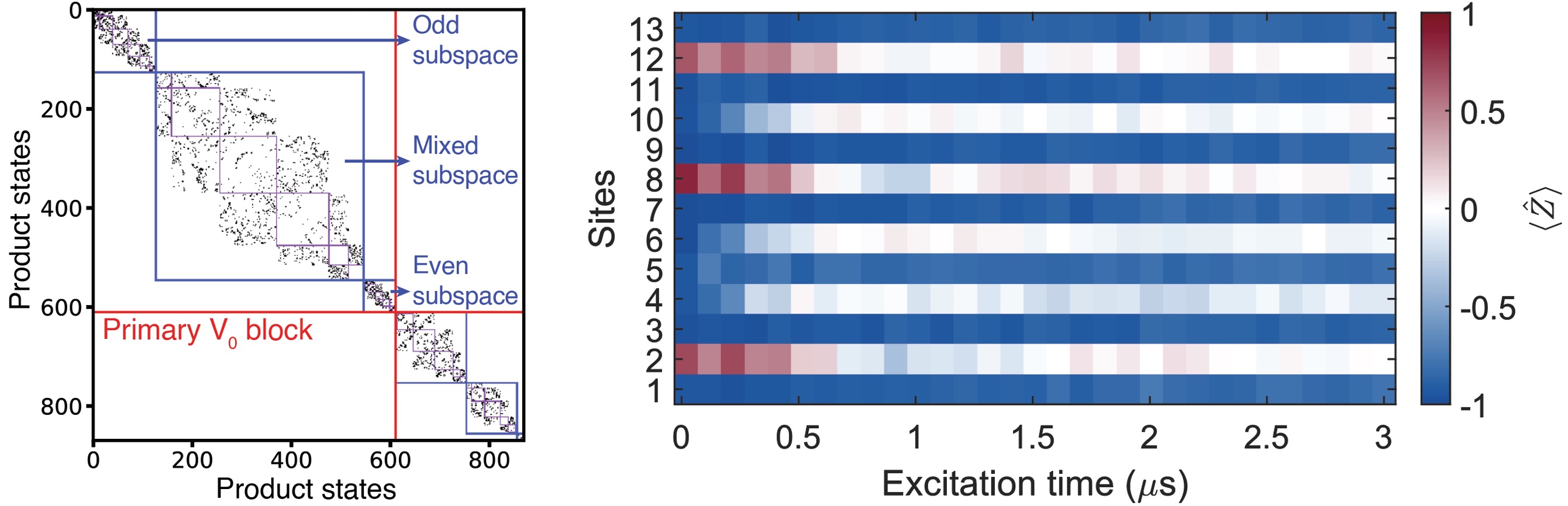
Our lab has recently found new ways to explore rich dynamics by engineering fractures in the Hilbert space of a quantum many-body system, such that the Hilbert space shatters into exponentially many disjointed subspaces. This opens up possibilities, for instance, to observe quantum thermalization in a way that runs counter to our conventional understanding and may be applied to control entanglement dynamics in quantum processors and quantum sensors.
Connections to lattice gauge theory
Fragmented state spaces are an important property of lattice gauge theories. We map our Rydberg atom arrays hosting a strongly fragmented Hilbert space onto a constrained U(1) lattice gauge theory, with which we observe that almost all states are localized despite the presence of nonlocal conservation laws - a phenomenon known as statistical localization.
